Community hubs

This is the global Feminist Blogs aggregator. It collects articles from many smaller community hubs within the Feminist Blogs network. For stories from particular places, groups, or other communities within our movement, check out some of these sites.

Share this fundraiser with friends online using ChipIn!

Support Feminist Bloggers!

Feminist Blogs depends on contributions from readers like you to stay running. We're doing a fundraising drive for the months of February and March.

Donations provide for the costs of running feministblogs.org and provide direct financial support to active Feminist Blogs contributors. See the donation page for more details.


Posts tagged International

RJ Events at Rutgers School of Law

There are two events happening at Rutgers in March and in April that are directly related to reproductive justice and women’s rights worldwide.  The first one is being hosted by the Rutgers Women’s Law Forum.  It is a screening of Mrs. Goundo’s Daughter, which is a documentary about a woman’s struggle to obtain asylum in the American immigration system.  If she is deported to Mali, she will have to bring her daughter with her, who would then be subject to Female Genital Mutilation, or excision.  Approximately 90% of women and girls in Mali are subject to FGM, some as young as two days old, which can lead to infection, reproductive problems, and death.  It is an ancient tradition, linked by some to Islam, that many people are fighting against in local communities, at the statewide level, and across the world.  The movie Mrs. Goundo’s Daughter explores not only the cultural and social issues surrounding FGM in Mali, but also reviews the legal process by which Mrs. Goundo attempts to protect her daughter from FGM. (more…)

India Approves Female Quota for Legislative Seats

In response to male-dominated politics throughout the country’s history, India has just approved a bill that would reserve 1/3 of all legislative seats for women candidates. The news comes just in time for International Women’s Day, on March 8th.

The country faces specific problems relating to women that have not been appropriately addressed up to this point. The World Economic Forum has ranked India 114 out of 134 countries based on gender disparities. Female infanticide is responsible for an unequal number of men and women in the country. Proponents of the bill hope that a critical mass of female legislators will solve this problem.

“Issues like female infanticide will no longer be seen as a soft subject but will become the core of the nation’s political agenda,” said Brinda Karat, a member of the Communist Party of India (Marxist), during the debate in the upper house.

Many are very resistant to the idea of a quota, even though it’s been done with success in places like Norway. I am in support of such a measure. It’s not even a 50% quota; it is 33%. I believe this can encourage more women to get involved with politics and feel empowered to put in the time and effort into running for office.

But some of those who opposed the bill claim they didn’t oppose it for sexist reasons. Instead, Laloo Prasad Yadav, leader of the Rashtriya Janata Dal party, said that he is against the legislation because it does not contain certain provisions for women of lower castes or religious minorities. Therefore, he claims, the bill won’t do enough to counter inequalities in Indian politics. As he puts it:

“We are being unfairly defamed as anti-women. All we want is that the women from real India, like those toiling in the farms and villages, are brought forward.”

Women currently have about 11% of the seats in Parliament in India. The United States isn’t a huge improvement over this number, where about 17% of Congress is female.


Much as you might expect

To recap: See Women owe society neither babies nor excuses. As this post does, it jumps off from the following remark by Australian Prime Minister Kevin Rudd to Nina Funnell:

At that point one of my friends introduced me, dropping in that I am completing a PhD. At this, Rudd rolled his eyes and in a terse voice lacking any sense of irony remarked that is the “excuse” that “all” young women are using nowadays to avoid starting families. Since then I’ve come up with numerous one-line retorts, but in the moment I just froze in shock.

I’d like to think this was a one-off thoughtless comment, but it’s not. It’s just a slice of the “wimminz are for babiez” pie. I’d like to share with you another slice, one Rudd might have thought of before making his comment, as this kind of sentiment is heaped on his deputy all the time.

Julia Gillard is Australia’s Deputy Prime Minister. And the Minister for Education, the Minister for Employment and Workplace Relations and also the Minister for Social Inclusion. She became the first woman to run the country (well, you know, apart from the Queen) when in 2007 she assumed the role of Acting Prime Minister while Kevin Rudd was overseas. I don’t like everything she’s done, but you’ve got to hand it to her, Gillard is an accomplished politician. Yet her short red hair is a constant topic of national conversation. In fact, Brisbane’s Courier-Mail has a whole gallery of her changing hairstyles! There’ve been rumours and jokes that she’s a Sekrit Lesbian because apparently some people (read: straight men) can’t deal with the idea of a powerful woman who doesn’t take shit and thus must, um, well, the logic fails, really. (I must say I am rather amused that my blog’s the number one result on google for the search term ‘julia gillard dyke’.) But the thing that has disgusted me the most have been the assertions that she’s not fit to lead and that her opinions don’t count because she hasn’t any children.

Famously, in 2007, Senator Bill Heffernan of the Liberal Party (Gillard and Rudd are members of Labor) said that Gillard wouldn’t do well at running the country because she is ‘deliberately barren’. He subsequently apologised. It was… well, you can imagine how jaws dropped across Australia. But it didn’t end there.

Recently there’s been a national discussion, shall we say, about virginity. This was sparked by an interview given to the Australian Women’s Weekly by Tony Abbott, who is the Federal Opposition Leader. (That is, the head of the Liberal Party. The role of the opposition party is to act as an alternative government, pushing against the government and being the rival party during elections. Liberal and Labor are the two main Australian political parties, so one is always in power or in opposition. The Liberal Party is actually the primary conservative party, and Labor is more to the left but not actually to the left. Anyway, back to Tony Abbott.) He discussed his advice to his daughters about virginity and his thoughts on abstinence in general; you can read a bit about it here. His remarks could take a post all on its own, but I want to talk about a chain of responses that ensued. Julia Gillard said, ‘Australian women want to make their own choices and they don’t want to be lectured to by Mr Abbott’. To which Liberal Senator George Brandis replied ‘the vehemence of her reaction in fact shows that she just doesn’t understand the way parents think’.

‘I think that although Julia Gillard is a very clever politician, she is very much a one-dimensional person and I do think her reaction, her over-reaction to the, in my view, quite unexceptionable remarks Tony Abbott made as the father of daughters, is not something she would have said if she were herself the mother of teenage daughters.’

Emphasis mine. Gillard continues to be treated as though she’s a person of fewer dimensions than some because she doesn’t have children. Less worthy of being in power, of having an opinion. She’s being held to different standards than a male politician without children in her position would be. Implicitly, she’s not worthy as a woman, because she’s not fulfilling women’s roles: she’s politically powerful and she’s not a mother. The way Gillard is treated is pretty disgusting, and it’s shameless and public, too.

We need to make it okay for women to be in public life; to be prominent, and powerful, and successful, and a woman all at the same time. We need to make it no big deal to be a woman with no children in the public sphere, and we need to make it viable to be a woman with children in same. We need to accept all women as proper women irrespective of whether they reproduce or not (which isn’t, as Brandis seems to think, a choice for everyone). We need to make it okay.

I salute Ms Gillard for holding her head up through all the bullshit she has to deal with.

Please Sign NOW’s Petition to President Obama to Ratify CEDAW

One of the very good things to come out of yesterday’s International Women’s Day was a call from NOW for President Obama to support ratification of CEDAW (Convention on the Elimination of All Forms of Discrimination Against Women).  CEDAW was adopted by the United Nations General Assembly in 1979 and is the most complete international agreement on basic human rights for women.  It “promotes not only women’s empowerment, but is also a foundation for peace and justice around the world.”   (NOW has a very good set of information about CEDAW, showing the importance of why the U.S. should ratify it.)

Since CEDAW was adopted by the United Nations General Assembly in 1979, 185 countries have ratified it.  However, even though the U.S. helped draft the treaty, it is the only industrialized country not to have ratified it.  It is another of the many failures of the United States to fully participate in important world-wide treaties.  CEDAW is extremely important for women’s rights.  But, in addition, since a large part of the reason that President Obama was elected was to improve relations with the rest of the world, his support of CEDAW would be a very good step to show that he is engaged internationally.  CEDAW absolutely needs to be ratified by the U.S.

NOW has created a petition to send to President Obama.  Please go to NOW’s web site to sign the petition!!  Here is what it says:

Dear President Obama:

While our nation has made an undeniable progress in advancing women’s rights in recent decades, we still have a long way to go. One significant milestone on our way to the equality will be the ratification of Convention on the Elimination of all forms of Discrimination Against Women (CEDAW), the Women’s Rights Treaty.

Women continue to be targets of sexual and domestic violence — at home and abroad. We are discriminated against in the workplace and elsewhere. Women in the U.S. and every other nation suffer from more poverty, less access to health care, less access to a liveable wage, and barriers to equal education. The Women’s Rights Treaty is a valuable instrument for combating these wrongs. CEDAW embodies the basic democratic values of fairness and equal opportunity. Ratification does not require any federal appropriations. Moreover, women across the political spectrum support CEDAW’s ratification.

I urge you to take leadership on this critical women’s rights issue. The public and the U.S. Senate must hear that you support women’s human rights and that ratification of CEDAW should wait no longer.


Women owe society neither babies nor excuses

There was a piece in the Sydney Morning Herald the other week you should have a read of, Don’t be rattled by the baby guilt trip by Nina Funnell.

Funnell was recently in attendance when Prime Minister Kevin Rudd gave a speech ‘about the ”crisis” of Australia’s ageing population and the various economic challenges we will face as a result.’ For context, Australia’s birth rate has been below the replacement rate of 2.1 since the 1970s and Australia is strict on immigration. After the talk, Rudd came to speak to some under-30s who had grouped together, including Funnell:

At that point one of my friends introduced me, dropping in that I am completing a PhD. At this, Rudd rolled his eyes and in a terse voice lacking any sense of irony remarked that is the “excuse” that “all” young women are using nowadays to avoid starting families. Since then I’ve come up with numerous one-line retorts, but in the moment I just froze in shock.

You should read the whole piece as Funnell takes this down beautifully. (‘Why do we assume it is the obligation of all women to reproduce? And why do we label them as selfish when they don’t? We never label career-driven men as selfish.’) I’m reluctant to tear apart Mr Rudd’s statement myself as, well, while the sentiment is pretty clear, what’s not clear from the article is what he said in full.

In any case, we can turn to the general sentiment. There are various harms in treating women as a monolith. I resent the assertion that not having children and at the “right time” is a bad thing. It holds women to be essentially baby makers who aren’t doing their duty to their country if they don’t follow the script – and this is something that needs an excuse. It also holds women responsible for the difficulties involved in pursuing higher academic study and starting a family at the same time. If Mr Rudd’s government, and governments worldwide, would be more supportive of those in that position, fewer people would have to face a choice between them. Until then, that some are put in this position is hardly their fault, hardly something for which women ought to be treated condescendingly.

What this script also does is assume that “avoiding” starting families (avoiding the right and inevitable thing, those naughty girlies!) is a choice for all women. Not every woman is able to reproduce or adopt or some such, or is able to keep their children if they do. Some women are actively forced into reproducing. And some women, rather than having this obligation to reproduce weighed on them, are considered to have quite the opposite obligation, to not reproduce at all. Disabled and poor women, for instance, are often discouraged – if not actively prevented – from having children. You know, supposedly for the good of society. Placing the emphasis on “avoiding” reproducing means adopting a monolithic view of women’s experience, erasing many. They’re written out of the script.

And, moving back to the idea that women who don’t reproduce according to the script owe excuses, I think it’s important to determine precisely to whom these women are supposed to be offering their justifications and apologies. Really, who? We’re autonomous human beings, we don’t need to go around with bowed heads and guilty expressions for doing as we please, or as we must, with our own bodies and lives. Women certainly don’t owe babies to society, or to politicians, or to those judging them, or to anyone at all.

Women’s reproductive choices should be ours alone. We ought to be accountable to our own desires in these matters, not those of onlookers who think they know better.

Next time, I’m going to return to Mr Rudd’s remark and some of its particular significance in Australia’s federal political context.

International Women’s Day: Women are the solution


Woman Power! by Yoko Ono, via Cara. Lyrics here.

This is a great song any day of the year, but is especially powerful today, on International Women's Day. We often read (and, let's be honest, even write here at Feministing) about the problems associated with being a woman in this world. We are targets of domestic violence and public harassment. We are pregnant and treated as nothing more than childbearing vessels, or we want to not be pregnant and are denied that choice. We are trans women and queer women and bi women whose very identity is treated as problematic. We are paid less for the same work -- especially if we are women of color. We are women with disabilities who are subject to shockingly high rates of abuse. We are more likely to go hungry, to live in poverty after retirement, to lack access to health care.

But the flip side of all of this -- that we are also the solution to these problems -- is something we should celebrate more.

To say women are the solution is not to say they are responsible for the deep, systematized reasons why they face disproportionate barriers to empowerment. Women are the solution because, when they are given the freedom and agency to make decisions for themselves, their bodies, their families, we make great strides toward correcting all sorts of inequalities in this world.

Let's get specific: Guttmacher has a new report on the remarkable gains that are possible for families and communities when you allow women to control their own reproductive destiny. On the Issues reports on what happens when women dismantle male-dominated political power structures. And the World Food Programme explains how women are the solution to global hunger:


Soundtrack is just instrumental. More info here.

To note that women are the solution might seem sort of, well, duh, to regular readers of this blog. But clearly the wider world has yet to take that message to heart. International Women's Day is a good chance to push it to do just that. As Yoko puts it, "We women have the power to move mountains."

Read more blogging for IWD here. Also, check out one of the 750 IWD events!

Tagged with:

International Women’s Day Posters

Everyone knows that today is the 100th International Women’s Day.  (Well, maybe everyone does not know it, since the day is not recognized by the United States, United Kingdom, France, Germany and Canada.)

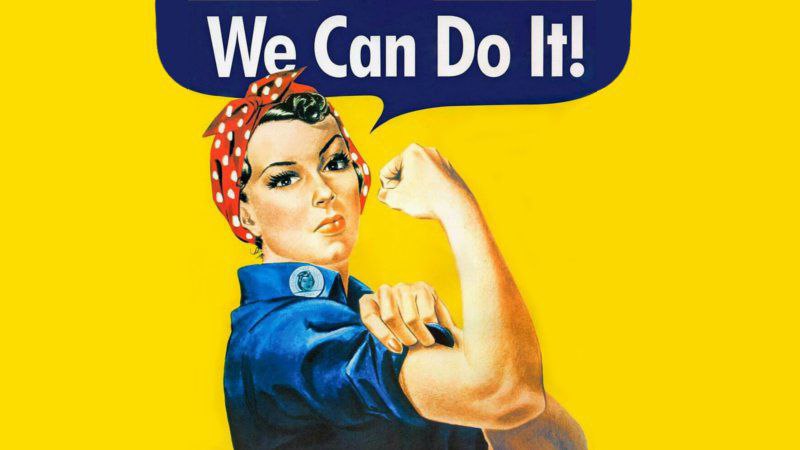
I’ve seen some of the posters that have been used over the years and they’re great.  The L Magazine has a set of 10 of them.  Here’s one of them from last year.

And here’s one from the Guardian that I really like.


Today in Feminist History: International Women’s Day

international women's day logo, white and purple with women's symbol

International Women's Day
has been celebrated for almost a century around the world. While it remains a more popular (and government sponsored) holiday abroad, many organizations and activists in the US also celebrate it.

International Women's Day has been observed since in the early 1900's, a time of great expansion and turbulence in the industrialized world that saw booming population growth and the rise of radical ideologies.

To read a timeline of International Women's Day history, go here.

For events happening in the United States, go here.

Beijing+15!

Hey people, did you know the UN’s Commission on Women is meeting to review the Beijing Platform for Action, which occurred in 1995,  and the Commission on the Status of Women, which happened in 2000? I’d heard it was happening but didn’t think of writing it up until a lovely commenter brought it up in my last post. So thank you! I’d forgotten how little attention some events I think everyone is aware of  actually get.

Here’s the text of the Beijing Platform

http://www.un.org/womenwatch/daw/beijing/beijingdeclaration.html

Some of my favorite parts are

32. Intensify efforts to ensure equal enjoyment of all human rights and fundamental freedoms for all women and girls who face multiple barriers to their empowerment and advancement because of such factors as their race, age, language, ethnicity, culture, religion, or disability, or because they are indigenous people;

Yay, intersectionality!!!

34. Develop the fullest potential of girls and women of all ages, ensure their full and equal participation in building a better world for all and enhance their role in the development process.

Woohoo!!!

I’m gonna say it here: I’m not the hugest fan of bodies like the UN. I mean, that’s a lot of lofty goals right there, you know? And the radical in this blog title isn’t a joke, I’m a big fan of direct action and advocacy. I’m not against the UN’s Commission on Women by any means. It just isn’t enough. Giving a set of vaguely unattainable goals to governments saturated in the patriarchy can only do so much. It isn’t enough. But it is something, and I look forward to seeing how it turns out and what conclusions are drawn from the evaluation.

And, Happy International Women’s Day!


Feministe All Over The World Redux

Recently I was taking a trip through the Feministe archives when I came across this post of Jill’s from 2007, Feministe All Over The World. She took a look at the Sitemeter stats, which show you where in the world the most recent visitors to the site are.

I’ve been taking looks myself at different times of day over the past few weeks; we have visitors from all over! Most of you are from the United States, much as you might expect, and there are also a fair few folks from Canada, Australia and the United Kingdom. We’ve visitors from New Zealand, India, Slovenia, South Korea, Germany, Norway, Morocco, Austria, Spain, Sweden, Colombia, Trinidad and Tobago, Yemen, Ukraine, France, Hungary, the Netherlands and the United Arab Emirates, and that’s only a sampling!

It’s a marvellous thing to know that you’re tucked away in front of your computer in your little corner of the world, yet you’re in community with so many people. So let’s see where we’re all from!

Leave a comment telling us where you’re from and, if it differs, where you live. Also, what’s the time where you are as you’re commenting?

I myself was born in Sydney, Australia, and live here still, though I keep threatening my family with moving to Denmark. It’s 8.17 on Sunday morning.

Tagged with: ,