Community hubs

This is the global Feminist Blogs aggregator. It collects articles from many smaller community hubs within the Feminist Blogs network. For stories from particular places, groups, or other communities within our movement, check out some of these sites.

Share this fundraiser with friends online using ChipIn!

Support Feminist Bloggers!

Feminist Blogs depends on contributions from readers like you to stay running. We're doing a fundraising drive for the months of February and March.

Donations provide for the costs of running feministblogs.org and provide direct financial support to active Feminist Blogs contributors. See the donation page for more details.


Posts tagged Race

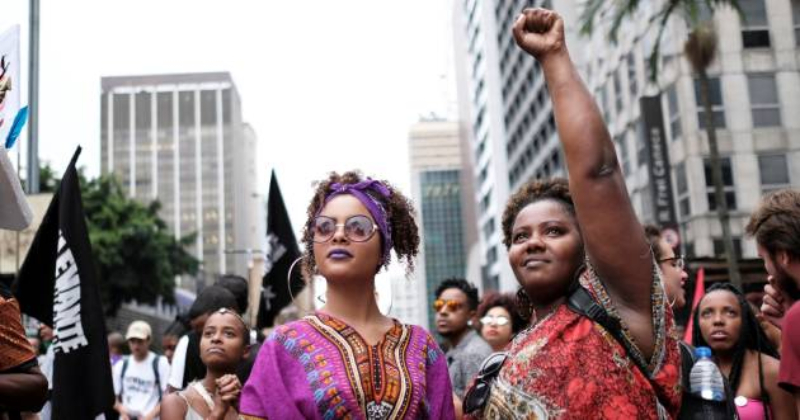
My Struggle with Feminism

This is a guest post of the presentation given by our incredible student panelist at the University of Iowa for our college tour, Conner Spinks. Just a freshman, Conner's insight, brilliance and general bad-assery absolutely blew us away.

To begin, I want to explain my own relationship to feminism. Personally, it has never been a word I shied away from. I was a loud mouth tom boy and I saw how my interest in tools and trucks over dolls was thought of as strange. I saw how confused my father was when I refused to put on a dress and if forced, would sit with my legs as wide as possible, which eventually led to pants anyway. My independent minded mother would try to calmly explain to aghast relatives that "No, she doesn't think she's boy, she just doesn't like dresses." Or her favorite, "No, she's just being Conner." Clearly, my mom doesn't subscribe to traditional gender norms. My name is Conner.

As I grew up and learned about the inequalities faced by marginalized populations, and discovered there was a word for the fight against those inequitable distributions of power, I was all over it! I was eager to claim the identity of feminist. That identity is something I still debate about labeling myself because that label to some is enough. There is no need to truly question your own relative privileges or power, you're a feminist. There's no need to listen to claims of struggle that you don't face, you're a feminist. Because of that label, you can't be ableist or transphobic, you're a feminist!

I am not calling in to question how a good a feminist someone is. I am questioning what feminism means to the students on this campus and that ambiguity is what causes me pause when it comes to applying the label to myself.

This campus especially has shown me these feminist in name only. People who have regressive views of gender are looked at like Neanderthals and openly argued against. But regressive views of race that are patently obvious to me, go unquestioned or even unnoticed. Sometimes, I have literally looked around and asked, "Am I the only who heard that?"

As a woman of color, it offends me more than anything to witness ridiculous displays of ignorance about race on this campus. Race is not talked about enough here because it's thought that we are post-racial because of all the progress made for communities of color. Even when there are obvious instances of racism, it is downplayed.

So the incidents where international students from China have racist graffiti written on their boards and people openly mock Chinese accents are treated as if cultural miscommunications. Ideas about English Only and mistaken ideas about America having an official language are not only condoned but widely held. Though this wasn't here on this campus, at ISU, a friend of mine who is both Asian American and lesbian was forced to break her housing contract and move out of the dorms because of the harassment she faced for being lesbian and Asian American. She had little recourse besides to leave.

There is some resentment of the largely black populations from larger cities that live in Iowa City. When searching for apartments, I saw multiple notices of "NO CHILDREN" or "NO SECTION 8." At the beginning of this school year, there was an editorial in our school paper, the Daily Iowan that noted how divisive Iowa City has become because of the North/South division, with the Southside being the largely black low income area. The talks surrounding the concentration of black people to the Southside never referenced the refusal on rental properties to rent to low income and/or people with families. Responses to the piece used euphemisms like "those people" and said everything but black. Even a highly racialized situation like that, there is a refusal to acknowledge race.

I have seen absolutely egregious displays of ignorance from women and men who claim the title of feminist. Within a gender studies classes, I have heard a young woman who claimed to be a feminist explain to me that a picture of a black woman dressed in jeans and a t-shirt was overly sexual. When I pressed for a reason why, she looked confused as if the answer were obvious. I sat staring at her in my own jeans and t-shirt, wondering how obscene my own body must be.

But my experiences with my fellow feminists are best summed up by an encounter with a young woman last semester. I just finished arguing with a friend of mine about the label of feminist because my friend believes in everything feminist oriented but the label. The young woman approached me to say that she proudly identified as feminist. We high-fived and after a beat, she did what a lot of black women fear. She raised her hand and asked me, "Can I touch your hair?"

That is not to say that my every experience with feminist on this campus was as offensive as someone trying to touch my hair, but it really is depictive of the state of feminism on this campus. There is a serious discrepancy between what it is in theory and how it is performed on this campus.

When I bring up issues of racism or nativism to some, they ask me how that relates to feminism. Feminism is especially for marginalized groups like POC and our struggles. Feminism is about explicitly fighting against the "-isms" that harass us POC on this campus. This is my feminism. I am a feminist.

Categories: Events

Day 10 – Feminist critics

I've woken late. I've got a cold.  In America we call it a sinus infection, but in England it's a cold and no one will pay you any mind for it.  I tell you this because what I'm about to say is critical.

When did the dominant mode of feminist criticism turn to listing what various women (and men) fail to include in the story of feminism (or anything else for that matter?).  When did we decide that a good mode of critique is pointing out what hasn't been included?  Was it sometime in the late 80s after Derrida's deconstruction became popular in the states?  Did the watered-down version of his theory taught in undergrad programs all across America give rise to this tendency to point to exclusion?  If so, I think we all need to return to the text and re-think.

I'm responding here to the F Words recent review of the BBC4 series 'Women'.  You can see the review here: http://www.thefword.org.uk/reviews/2010/03/women

The reviewers point out that no women of colour nor any ethnic group has been portrayed in this series.  This is without question true.  However, the reviewer fails to take the text into consideration.  What is the purpose of this text?  Is it to present an all-encompassing history of the women's movement?  Will it become the dominant mode by which millions understand the history of the movement?  No.  Without doubt.  No.  The history will be written, luckily, by a multitude of participants and historians, who like many of us have access to Word Processing programs and camera equipment. 

The reviewers want the white Vanessa Engels to access a racial experience that she simply cannot. Sure, she can interview black leaders of the movement, but can she really talk to them about race?  Will the questions falling from her lips illicit from those women the truth and hardship of their struggle?  I doubt it.  Especially in America where to talk of race openly puts most of us into roles we have no idea how to negotiate. 

Race is an incredibly complicated issue for Americans.  If it had been included into these documentaries, it would have been been watered-down, or added on as a supplement to the larger history.  I'm certain that that is not where I want to see race placed - as an add-on, a 5 minute nod to unimaginable struggle. 

To accuse this series of documentaries of racial prejudice is to ask for tokenism.  It is to suggest that if you just put one or two black women into the picture, the picture will be clearer. It won't.  It will still be the picture created by a white, British woman. As it currently stands, the series owns that. 

What would be awesome is if someone talented and smart could find funding for a series on the ethnic struggle in America during the feminist movement.  I fully support that and if anyone is looking to make that happen, I'm here to help.
Tagged with: ,

New report highlights serious wealth gap for women of color

A new report from the Insight Center for Community and Economic Development paints a harsh picture of the wage gap that exists for women of color.

We've known there is a gender based wage gap for a long time, and that race also plays a factor. But this report, which compares the wage gap of white single women to that of single women of color, puts the challenges into perspective.

  • Single black and Hispanic women have a median wealth of $100 and $120 respectively; the median for single white women is $41,500.
  • Nearly half of all single black and Hispanic women have zero or negative wealth, the latter of which occurs when debts exceed assets.
  • About one-third of single Hispanic women and one-fourth of single black women have no checking or savings account.
  • On reservations where unemployment rates can be as high as 70 percent, Native American women are hard pressed to fulfill "job search" requirements to qualify for the Temporary Assistance for Needy Families program.
  • While 57 percent of single white women own homes, only 33 percent of single black women and 28 percent of single Hispanic women are homeowners.
  • Only 1 percent of single Hispanic women and 4 percent of single black women own business assets compared to 8 percent of single white women.
  • While 66 percent of white men and 60.4 percent of white women receive retirement income from assets, the same is true for only 40 percent of Asian women, 25.4 percent of black women and 23 percent of Hispanic women.

It's these types of wealth disparities that can translate into cycles of poverty for generations to come.

The report
also includes recommendations for addressing these wealth gaps.

Tagged with: ,

March 4 Day of Action: Healing the University of California

On the morning of California's largest statewide strike and Day of Action for Public Education to date, University of California campuses continue to be plagued by a slew of racist, homophobic, Anti-semitic and transphobic actions.

****Trigger Warning****

Hate Round-up:

LGBT Resource Center Vandalized at UC Davis

The word Fag is spray-painted over the LGBT resource center sign.

This was discovered Saturday morning. There are responses from the LGBT Resource Center and from the Co-Chair of the State UCLGBTQIA Association.

Swastika Carved into Jewish Student's Door at UC Davis

The incident is being investigated as a hate crime.

Compton Cookout at UC San Diego

Several weeks ago, UC San Diego students threw a "ghetto-themed" party with a long, racist description of costume requirements:

"For girls: For those of you who are unfamiliar with ghetto chicks-Ghetto chicks usually have gold teeth, start fights and drama, and wear cheap clothes [...] They also have short, nappy hair, and usually wear cheap weave, usually in bad colors, such as purple or bright red. They look and act similar to Shenaynay, and speak very loudly, while rolling their neck, and waving their finger in your face. Ghetto chicks have a very limited vocabulary, and attempt to make up for it, by forming new words, such as "constipulated", or simply cursing persistently, or using other types of vulgarities, and making noises, such as "hmmg!", or smacking their lips, and making other angry noises, grunts, and faces. The objective is for all you lovely ladies to look, act, and essentially take on these "respectable" qualities throughout the day."

UC San Diego Student Radio Station hurls racist slurs

Students from the station called protesters of the Compton Cookout "ungrateful n*****s" on air. A note with the words "Compton Lynching" was found on the ground.

Noose hung at UC San Diego library

Noose hung over a light fixture.

The student who confessed to hanging the noose maintains she had no racial motivation, and that she simply found a piece of rope while with friends, her friend tied it, brought it with her to the library, and left it there by accident. A note was found saying, "More Nooses to Come."

KKK Hood Placed on Statue at UC San Diego

Tuesday, Dr. Seuss's birthday, his statue was adorned with a KKK hood and a rose was placed in his fingers.

Noose Drawn at UC Santa Cruz

The words San Diego and Lynch are separated by a hand-drawn noose on a bathroom stall.

Administrators found this in a UC Santa Cruz restroom. The word "Visionary" is written below it.

The "Irvine 11" at UC Irvine

A flyer says 'Stand with the Eleven' with a picture of two men, arms raised in protest.

Eleven students at UC Irvine protested the visit of Michael Oren, the Israeli ambassador to the United States, and were arrested because their choice to exercise free speech happened to concern Israel. Faculty have battled over whether their protest or their arrest was the "true" act of prejudice. The students were removed from the event one by one, by police officers, and now as a collective group, are being threatened with expulsion. Their punishment is inordinate because of the subject matter they were protesting.

Two LGBTQ-identified UC Riverside students attacked

This hate crime occurred on February 10. Two UCR students, holding hands, were attacked by 3 assailants, who beat them while shouting anti-gay epithets in an area directly located off of the campus.

Noose Drawn on Black figure at UC Berkeley residence

This month, a UC Berkeley cooperative student housing facility had a mural defaced with a noose drawn around a black figure. It was cleaned up.
--

I grew up blocks from UC Davis. I spent last Christmas with my partner in Riverside, where we couldn't hold hands because we felt it was an unsafe environment. We were right. My childhood friends attend Santa Cruz, I attend UC Berkeley, and I was at UC San Diego with hundreds of other students for the Students of Color Conference last November. The University of California system is hurting, and emergency townhalls are being called across the state, especially in the LGBT and black communities. It's a scary time to be queer, a person of color, or both in California today. Luckily, some students respond intelligently.

Tuesday, UC Davis held a queer townhall and UC Santa Barbara planned a townhall for next week. Wednesday, UC Berkeley held a queer townhall, as well as a teach-in in preparation for tomorrow's statewide Day of Action for Public Education. But as we Berkeley organizers gathered Tuesday night to plan the queer townhall, debating for hours whether to create a space for healing or a space for action, we realized that we ourselves had not yet processed the blows dealt to our communities. Presented with dozens of images of hate on the Berkeley campus and systemwide, students embraced a new slogan: "Real pain, real action."

The UC Berkeley Black Recruitment and Retention Center held a "Black-out" Monday, where around 200 members dressed entirely in black and silently blocked the entrance to Sather Gate, the most prominent walkway on campus, to represent the invisibility of black students on UC campuses.

Hundreds of black students dressed in black, with faces covered, block a gate.

At Monday night's Emergency Black Townhall at Berkeley, a student leader explained the reason for limiting this action to black students only: after the Compton Cook-out and the noose found at UC San Diego, it was necessary to unify the scattered and wounded black community and "Get from -1 to zero." Then, with the help of allies, Berkeley can move "From zero to 1."

March 4 will be a statewide success, with marches, protests, picket lines and strikes, rallies, sit-ins, occupations, legislative lobbying, and impressive action on the magnitude of K-12, community college, state university, and University of California involvement. We might wake up and see fire on the news. But just as the budget cuts, fee hikes, police brutality, and violent response to student occupations deteriorate the UC system, so do the racist, transphobic, and homophobic actions across the state. Chancellors will send out emails praising police actions, and these hateful incidents will be ignored for a day as administrative buildings are locked or shut down statewide.

pictures of protesters and the words march 4 strike from diego to the bay- day of action for public education.

But it's no coincidence that the students targeted by these hateful incidents, black students, LGBTQ students, and all underrepresented or minority students, are among those driven away from higher education by tuition increases. Tomorrow, the students on the front lines will be fighting not only for the right to step foot on a college campus, but to feel safe when we arrive. California students, staff, parents, and faculty will unite today for higher education, but we all have some healing to do first.

Keep track of March 4 events at the UC Student Regent's blog, or twitter.

Related:
University of California Walkout Today
Police Brutality against CA Protesters for Higher Education

NC: State senator refuses to meet with P-FLAG, NAACP after bigot eruption

by Pam Spaulding

State Senator Jim Forrester (R-Gaston), is filled with hate for the LGBT residents of North Carolina. This legislator has, for the last six years as the first order of business, filed a marriage amendment (that has failed to reach a vote each time). He is also in favor of preventing gay and lesbian couples from adopting.

In his latest bigot eruption, Forrester adds overt racism to his dance card, blaming the states increasingly progressive tilt to blacks that dare to vote, as well as the Homosexual Lobby in the state capital of Raleigh.

I kid you not.

“The (state) Senate is as liberal as I’ve ever seen it,” Forrester said at the monthly meeting of the Iredell County Young Republicans on Tuesday night in Mooresville.

Slick city lawyers and homosexual lobbies and African American lobbies are running Raleigh,” Forrester added.

...So it may be viewed with some irony that Forrester said the GOP would likely have taken back control of at least one chamber of the General Assembly in 2008 had it not been for what he called the “Obama Tsunami.”

It brought a lot of blacks out who don’t normally vote,” he said.

The 10-term Republican (who is running unopposed this year) then tossed barbs at outgoing State Senator Julia Boseman.

He said state Sen. Julia Boseman — the first openly gay person ever elected to the North Carolina General Assembly — ”took a bunch of money from a big lesbian group.” Forrester said a male senator is rumored to be gay and is currently fighting off charges that he shot another man.

“And I say good riddance to them,” Forrester said. He said that neither of the two legislators showed any support for bills Forrester proposed to ban same-sex marriage in the state.

Forrester noted that he “is not against homosexuals.” He said he has gay patients who see him in his medical practice “and I treat them like everyone else.”

Any self-respecting, sane gay or lesbian in his district should not give Forrester one damn dime to his medical practice.

The local chapter of P-FLAG, led by Amy Sifford and Robert Kellogg, contacted Forrester to invite him to a face-to-face meeting to discuss his comments. Kellogg also approached the Gaston NAACP to see if it would participate in a joint meeting with Forrester (that chapter president, Clyde Walker, has requested the state leaders’ advice on how to respond to the legislator).

Forrester’s reaction?

Forrester said Friday he would decline the invitation from the Gaston County chapter of Parents, Families and Friends of Lesbians and Gays because he believes he’d be criticized for his conservative policies, particularly his stance against same-sex marriage.

I doubt I will go to the meeting, but I appreciate the invitation anyhow,” Forrester said. “I don’t think it would be a constructive meeting. I think it would just increase animosity toward me, and I don’t want that.”

Gee, I wonder why?

PFLAG’s invitation was e-mailed to the senator on Friday, Kellogg said. Forrester said he would read it with interest, but said a meeting with the group would be unlikely.

They don’t like my philosophy of traditional family values,” he said. “I don’t believe what they believe and they don’t believe what I believe, and they’re entitled to do that in this free country of ours.”

The Blend was contacted by Robert Kellogg, asking us to publicize this effort to start a dialogue on diversity with Forrester:

I would appreciate any help you could give in attempting to convince our state Senator to respond to the calls of his constituents and explaining the meaning of his words.

The fact is that if Dr. Forrester is a responsible physician who treats gay constituents, why is Sen. Forrester trying to legislate against any and all civil rights for his patients? At the very least he should meet and not dismiss them—as a lawmaker.

A portion of the P-FLAG letter is below the fold.

Sen. Jim Forrester has a long history bigoted comments and proposed legislation against gays, now it appears as though African-Americans as well as lawyers can be added to the list.

The Gaston County chapter of PFLAG (Parents, Families and Friends of Lesbians and Gays) would like to take this opportunity to state passionately how offensive and unprofessional Senator Forrester’s remarks were.

Senator Forrester made several references to homosexual and African-American lobbyists running Raleigh.  Forrester also pointed out his opposition to recent legislation which has advanced civil rights for both African-Americans and the gay/lesbian populations of North Carolina, to which we ask the following:  If Senator Forrester is against African-American and LGBT civil rights advancement, then what other minority group is he against?

To paraphrase Martin Luther King, we believe in a world where people should be judged on the conduct of their character rather than the color of their skin, who they fall in love with or any other defining characteristic or minority persuasion.

Senator Forrester stated that he did not intend to offend African-Americans or gays and hopes those who were hurt by the remarks will accept his apology.  PFLAG, alongside of those constituents of the senator’s who were hurt or offended by his comments, would like to invite the senator to a face-to-face discussion on diversity and minority orientations.

PFLAG Gaston hopes the senator will take us up on our invitation for a dialogue where he can apologize face-to-face to those he hurt with his careless comments.

If Senator Forrester decides against a face-to-face meeting with the offended minorities of his district, then we hope he will think twice about the language he uses regarding African-Americans and the LGBT communities of North Carolina in the future.

Sincerely,

Amy Sifford and Robert Kellogg
Executive President and Vice President of PFLAG Gaston

James Forrester
Email: Jamesf@ncleg.net
District:  41
Counties Represented: Gaston, Iredell, Lincoln

NC Senate
16 W. Jones Street, Room 1129
Raleigh, NC 27601-2808
(704) 263-4716

Related:
* NC: Freeper on the homo-filled Triangle: it’s ‘SICKENING TO see DIXIE become so weak’
* NC: homophobic fact-free rant of conservative state senator’s activist wife exposed

Black women breastfeeding: a multigenerational story

Saw this on Women's eNews, and wow!

Tagged with: , ,

Limbaugh calls health care reform “reparations” and “civil rights”

by Amanda Marcotte

This is really hard to listen to, since Rush Limbaugh is being even angrier and nastier and egotistical than usual, but it’s nonetheless important if you want to understand the opposition to health care reform:

In it, Limbaugh uses high racialized language to denounce health care reform, calling it “civil rights” and “reparations” in these tones that are dripping with anger and disdain.  The context for this is a discussion about the evils of social welfare spending that allows the people who build wealth through labor to enjoy some of the fruits of that wealth through taxing people who build wealth through capital and hoard most of the wealth for themselves.  From a fairness point of view, people who work to build wealth should get part of the bounty for the country, and the most efficient way to do this is through taxation.  Most people, if they think about it, do think that the social contract should include those who labor as well as those who invest money.  So the way that Rush and his comrades are able to distract people and have them offer their loyalties not to their fellow citizens who have to work for a living, but to those whose work is mainly in investing, is to draw on race.  He’s using language that basically says, “Working white people: Ignore the fact that you have the same concerns and hopes and dreams as working black Americans.  Instead, your loyalty and decisions should be made on hoarding wealth in the hands of white people and keeping it from black people.  That doing this means you don’t get your share of the pie is too bad, but at least most of the people who get most of the money are white.”

Conservatives like to pretend that liberals “cry racism” about opposition to health care reform because of President Obama, as if we’re saying all criticism of the man is racist in and of itself because of his race.  And of course they like to pretend that; it’s easier to argue with than the actual argument.  The actual argument is that opposition to social welfare spending is largely rooted in this race-baiting that Limbaugh is engaging in.  The argument is that the tea parties are mainly white because some white people are so opposed to sharing with people they think are inferior to them that they will shoot themselves in the foot in the process of hitting those folks with the bullet. We’re saying that they see America in terms of black and white and not in terms of rich and not-rich, and so when they think of “wealth redistribution”, they think of it as going from a mostly white upper class to a more racially diverse working and middle class, and they get upset at that.  This would all be true if we had President Clinton instead of President Obama, though I do think the fact that we have President Obama is probably escalating the racism of the teabagger movement.  But it’s not the source of it by a long shot.

That’s also why the fact that most teabaggers are tipping the age scale is relevant, as well.  While there’s no shortage of racial resentment with younger white Americans, it’s certainly milder on the whole than with the older crowd. The younger you go, the more likely you are to find a willingness to get along and share and see ourselves as a single group---Americans---and less as a bunch of racially separate people at odds with each other.  Also, the younger you go, the more racial diversity you find, so again, you’re less likely to see that group as a whole choose preserving the extreme wealth of the few on top because they’re white over self-interest.  Conservatives are genuinely in trouble in the long run because of this, which is why some of their attempts to appeal to young people are so laughable.

Tagged with: ,

Jay Smooth Takes the High Road on Celebrity Racism Spectaclepalooza

Well, you already know what I had to say about John Mayer, but uh...what Jay said!

Tagged with: ,

The Feministing Five: Emily Abt

emilyabt.jpgEmily Abt is an award-winning feminist filmmaker and the founder of Pureland Pictures. Her first film, a documentary called Take it From Me, was about the impact of American welfare policies on individual Americans. Since Take it From Me came out in 2001, Abt has made several more films, including All of Us, which is about African American women and HIV/AIDS and most recently, Toe to Toe, a story about young women, race, sex and friendship, that screened at Sundance this year.

Abt, who spoke on a panel with our own Courtney Martin at the 92nd St. Y earlier this month, says that she hopes that the film will encourage audiences to think about the issues it addresses, and especially about the sexualization of young women and interracial friendship. This semester, she's teaching a class on social issue film at Princeton University, my alma mater, and my campus spies tell me that the class is "so damn good."

You can check out the trailer for Toe to Toe here, and learn more about Abt's earlier films here.

And now, without further ado, the Feministing Five, with Emily Abt.

Chloe Angyal: What led you to making films, and specifically to making a film about the issues you tackled in Toe to Toe?

Emily Abt: I came to filmmaking in a roundabout way; I used to be a caseworker. And I was doing that right when the Personal Responsibility Act was going through, and the way we treated poor people in our country was changing drastically. There were time limits being placed on public assistance, and work requirements, and I felt very much in the middle of that, as a caseworker during that time. And I had always loved films, and I decided that I wanted to make a documentary that captured the human impact of what I was witnessing. So that's what I did. I followed four of my former clients over a couple of years, as they transitioned from welfare to work, and I ended up selling the film, Take it From Me, to POV, which is PBS' premiere independent documentary series. And that was an incredible experience, and I had beginner's luck in that I was able to sell this film, without having had a lot of experience beforehand. So that's how I got started, thirteen years ago.

I'm very much a social issues filmmaker and very much a feminist filmmaker, and I think that the two things that Toe to Toe deals with in terms of social issues are the sexualization of teenaged girls and race. With the character of Jesse, I'm basically trying to get audiences to look at the sexualization of teenagers, and of teenaged girls specifically, and ask themselves if that's always such a good thing. I think given current statistics - one in four teenaged girls has an STD, teen pregnancy rates are increasing - that it's a really good time to be having that discussion. So that's one of the things Toe to Toe takes on. It also focuses very much on race relations. I hope that people will be inspired by the authentic relationship that Tosha and Jesse have, in that the girls are very honest and direct with each other. They come from very different backgrounds, but what they have in common is that they're both truth tellers. It's not a "kumbaya" film; they don't have an easy relationship, but it's a strong and a real one, and ultimately they're willing to sacrifice a lot for each other.

That whole storyline was encouraged by the fact that for 87% of Americans, their interracial friendships end at age fourteen, which I thought very much went against the way we like to think about race relations as a country. That's a New York Times statistic from a story they did a few years ago, it was a series on race relations, and I read that statistic and it really really jumped out at me. So I'm hoping that audiences will be inspired to reach a little bit further in terms of their own relationships and not be afraid to have some of those awkward conversations that a lot of people avoid, but that ultimately can bring you closer.

CA: Who are is your favorite fictional heroine, and who are your heroines in real life?

EA: For fictional heroines, I like the two girls in my film, Jesse and Tosha. I think they're brave.

My heroines in real life are my mother, my aunts, my many good girlfriends. I'm a fan of Hillary. They're strong and outspoken.

CA: What recent news story made you want to scream?

EA: I think Martha Coakley has gotten pretty beaten up in the press, but I also think a lot of that is appropriate. I guess I sort of wish people would leave Sarah Palin alone. I sort of feel sorry for her, and I don't find it that interesting to keep giving her foibles that much attention.

CA: What, in your opinion, is the greatest challenge facing feminism today?

EA: I think that there's two. I think that a big challenge is getting young women to identify with feminism and as feminists. I also think that feminists really have their work cut out for them in terms of what's going on in countries like Afghanistan and the Ivory Coast, places where there's a lot of violence against women. I think the greatest push should be around those areas. Obviously, feminists in our country have domestic things to work on in terms of the availability of abortion and all that, but I feel like the most urgent needs are in places like the Congo and Afghanistan.

CA: You're going to a desert island, and you're allowed to take one food, one drink and one feminist. What do you take?

EA: I would take avocado, a big glass of milk, and Bella Abzug. She was such a badass. If I could talk with her anywhere that'd be great, and a desert island would certainly do.

Tagged with: , , , ,

Famous African American women

By: Bre - from the series of guest posts written by Dr. Baldwin's students at Michigan State University.

So with February being Black History Month I decided to actually do what they wanted us in elementary school to do. I started to research and read about different women’s lives and their achievements towards equality. I read quite a few and was quite amazed at the difficulties that these women had to overcome for our modern world to be become more equal. For example, Daisy Bates guided and advised the Little Rock Nine. The nine children that voluntarily forced a white school to integrate and allow black children in. During this time she was arrested and voluntarily went to jail for a violation of a city ordinance just for helping and protecting the children. Also she and her husband started and wrote a newspaper that voiced civil rights, before the Civil Rights Movement was even a movement. She later went on to improve the life of her community until she died in 1999. But what makes her truly stand alone is that she was the only female civil rights leader to speak at the March on Washington in 1963.

Mary McLeod Bethune also lived to improve her community. She founded a school for African American children, now known as the Bethune-Cookman College, in 1904. At the time she was only one of a few women who were the president of a college. The school she founded surpassed the standards of traditional black schools and rivaled those of white schools. She was also president of the National Association of Colored Women. And among her list of credentials she was also a member of Roosevelt’s “Black Cabinet” whose purpose was to raise concerns about the black community.

One more woman I want to mention, that I believe should be a role model to everyone is Dr. Maya Angelou. She experienced many hardships growing up as many people of her race and of her gender also did. She spoke about many of these in her book “I Know Why the Caged Bird Sings” which memoirs her childhood. She worked closely on the civil rights campaigns of Dr. Martin Luther King Jr. and Malcolm X. And was even a world wide activist with her early career in West Africa. Dr. Maya Angelou was even appointed to many capacities by many presidents and read an original poem at President Clinton’s inauguration in 1993.
Tagged with: , ,